The United Natural Products Alliance (UNPA) and the China Chamber of Commerce for Import & Export of Medicines & Health Products (CCCMHPIE) launched the U.S.-China Dietary Supplement and Food Ingredient Supply Chain and Trade Cooperation Initiative.
The initiative builds on the organizations’ memorandum of understanding (MOU) to strengthen ingredient supply chains supporting U.S. manufacturing and develop a practical foundation for more reciprocal trade. Although UNPA will sunset at the end of 2026, the legal entity UNPA Inc. will manage the partnership.
Phase I focuses on Chinese ingredients entering the U.S. and connecting supplier documentation, testing and traceability with purchaser requirements. Phase II focuses on American finished products entering China and linking ingredient sourcing, manufacturing controls and finished product testing with Chinese market access regulations.
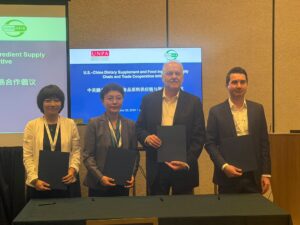
On Oct. 29, UNPA and CCCMHPIE co-hosted an event at SupplySide Global (SSG) at the Mandalay Bay Convention Center in Las Vegas, NV, which elaborated on the initiative and had both organizations sign the agreement documents. The event was moderated by Loren Israelsen, founder and president of UNPA, and the 20-member Chinese delegation was led by CCCMHPIE President Dongping Meng.
The speakers focused on various aspects of the relationship between UNPA and CCCMHPIE and some of the approaches they’re using. The goal of the initiative is to create incentives for Chinese companies to improve quality and GMP (good manufacturing practice) compliance and do more business with American companies. The event had live translation in both English and Chinese.
“The central idea is that we have to really consider a fundamental way of changing our thinking about the supply chain, specifically between the United States and China,” Israelsen said. “We all know China is the major supplier to our industry and China is a major consumer of our products for export. And yet, the supply chain systems we’ve been using now for decades [are] very outdated and we think it’s time to really fundamentally rethink how we approach the supply chain.”
At the event, Daniel Mabey, Asia region president and director of strategic markets at UNPA, explained the initiative is a voluntary two-phase reciprocal trade program. The association wants as many U.S. industry stakeholders as possible so it can provide the most accurate and most beneficial resources for bilateral trade.
“We built a template for these companies to assess their supplier manufacturing site, their audits, current certifications, and current COAs that are representative of the products that they’re currently exporting to U.S. market, we’re going to work through the China Chamber of Commerce and their good extract practices standard to really create kind of the first baseline for qualification,” Mabey said. “Obviously, we also need to have companies have audits that are in compliance with U.S. regulations…but we believe that the botanical segment of industry is really a critical area to focus on because of issues with adulteration spiking and price wars here on the U.S. side.”
Mabey said UNPA is working to receive feedback from the industry and develop a consistent, standardized information and supply framework.
“If you look at ginkgo, for example, many of the Chinese representatives here have often told me what the spot market price of ginkgo is in China versus the U.S., and it’s actually lower priced here in the U.S. than it is in China,” Mabey said. “So, that means that there’s obviously something going on here. So, we’re really trying to streamline the trade, structure the chain of custody, and then implement testing protocols in China, working with international laboratories to test the COAs (certificates of analysis)asymmetric information against third-party testing evaluations.”
According to Mabey, UNPA wants American companies to build direct supplier relationships with Chinese manufacturers. He said both companies have a lot of “asymmetric information.”
“I’ve even noticed that, just in terms of communication channels, the Chinese are all on WeChat. There’s a lot of information in China that you can’t really access from the U.S. market, and we need to really begin to streamline and introduce U.S. companies with their Chinese suppliers so that they can connect directly through their QA [quality assurance], R&D teams and have that kind of technical correspondence and coordination with U.S. companies that are buying these ingredients,” Mabey explained.
Meng said CCCMHPIE talked with many American brands during SSG, and everyone is seeking high-quality brands—especially botanicals and nutrition goods. She said expanding raw material production and consumer base has led China to become a key power in the global supply chain. Global consumers want natural, organic and green products, and a safer and more stable supply chain.
“This year, China’s government proposed a policy that we should put more emphasis on the theory of traditional preventable diseases. So, this idea has changed a lot and changed direction of the development of this industry,” Meng said. “I mean, we could see American supplements very well sold through the e-commerce trade in China cross-border. So today, it’s safe to say that Chinese market is a must-have market for American brands/American companies. So, Chinese extracts have clear advantages of quality and variety in price, and they are used widely in American products. So, I want to strengthen it. Our two countries and our two industries are deeply connected.”
Dexiong Deng, commercial counselor at the PRC Consulate General in San Francisco, CA, added the natural products industry shows how much the U.S. and China can gain from working together and the relationship between the two sides regarding ingredient sourcing, R&D, manufacturing and sales.
“We need to stay in close contact and address problems through dialog and consultation, so business can play with greater confidence and ability. We hope this will lead to lasting partnership and concrete business results. China remains committed to creating more opportunities for businesses around the world, including those in the United States,” Deng said. “We hope you will continue to explore the Chinese market with confidence, aware of the opportunity of meetings like this to find new partners and strengthen the relationship you already have. And the Chinese Consulate General in San Francisco will continue to support business exchange and help in whatever way we can. We look forward to working with you to strengthen partnerships in the natural flow of energy and bring great value to businesses and consumers in both countries.”
For more information, visit www.unpa.com or www.cccmhpie.org.cn.