Flavonoids, a diverse group of phytonutrients found abundantly in fruits and vegetables, are classified as polyphenols and are widely recognized for their health benefits. Upon ingestion, flavonoids exert positive effects on the digestive system through several mechanisms, such as antioxidant and anti-inflammatory properties that protect digestive tract cells by mitigating symptoms associated with inflammatory bowel diseases, such as Crohn’s disease and ulcerative colitis. Furthermore, flavonoids impact the composition and function of gut microbiota, promoting the growth of beneficial bacteria while inhibiting harmful bacteria, which ultimately supports gut health. They also strengthen the integrity of the intestinal barrier, thereby reducing the likelihood of leaky gut syndrome and preventing harmful substances from entering the bloodstream.
Only a small fraction of the original form of flavonoids can be directly absorbed by the intestine. Conjugation and other chemical modifications, influenced by both intestinal cell enzymes and microbiota, are essential to allow a significant absorption of flavonoids. These metabolic processes also determine their biological activities after absorption, which include local effects within the gastrointestinal (GI) tract and systemic effects on distant organs. The high concentrations of flavonoids in the stomach and upper intestine allow them to exert direct effects on the GI tract tissue and lumen. These local actions can also contribute to systemic effects of flavonoids, such as secretion in hormone incretins released by the GI tract, influencing systemic regulation and potentially offering broader health benefits.
Secondly, flavonoids interact with the gut microbiota, leading to changes in the composition of the microbiota profile that can stimulate the growth of beneficial bacteria. The metabolism of flavonoids promoted by intestinal microorganisms produces smaller molecules (aglycones) that can be absorbed into the circulation and subsequently reach distant organs.
In the intestinal epithelial cells, flavonoid conjugates are transported via enterohepatic circulation to the liver and distributed to various organs, where they may undergo further metabolism and exert local biological effects. While only a small fraction of deglycosylated flavonoids by microbiota are absorbed, the majority are degraded into short-chain fatty acids (SCFA) and phenolic acids, which contribute to maintaining microbiota homeostasis and provide other beneficial effects on human metabolism (Figure 1).
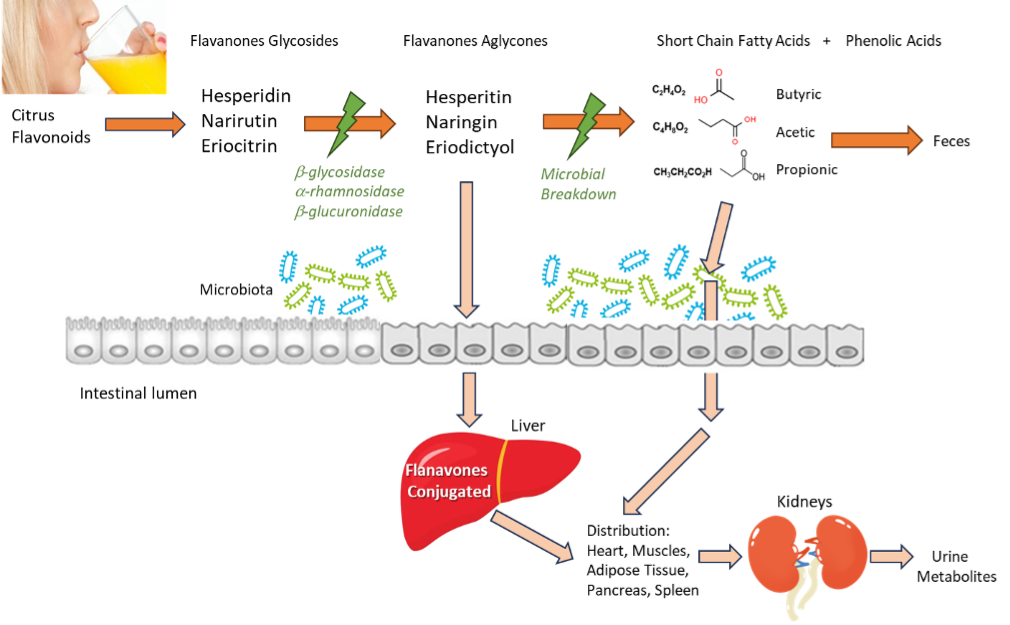
Citrus flavonoids, or flavanones, are predominantly found in citrus fruits and certain herbs as flavanone glycosides, meaning they have one or more sugar molecules attached to the primary flavanone structure (aglycone). The glycosidic structure, which includes one or more sugar molecules attached to the flavanone, increases their solubility and stability but hinders their digestion and absorption in the small intestine. As a result, a significant portion of flavanone glycosides reaches the colon intact, where they are then hydrolyzed by enzymes from intestinal bacteria, allowing the absorption of the flavanone aglycones.
Among flavonoids, eriocitrin is particularly noteworthy for its beneficial effects on health, especially on metabolic abnormalities such as metabolic syndrome, dyslipidemia, hyperglycemia and prediabetes. Eriocitrin, also known as eriodictyol-7-rutinoside, is a key component of citrus fruits, especially lemons and limes, due to its potent biological activities. Structurally, eriocitrin is composed of the aglycon portion, eriodictyol, bound to the disaccharide rutinose. This glycosidic structure enhances the compound’s solubility and stability, improving its bioavailability and functionality in biological systems. Upon ingestion, eriocitrin undergoes metabolic transformations in the GI. The gut microbiota plays a crucial role in the biotransformation of eriocitrin, converting it into various metabolites with potentially enhanced bioactivity. Eriocitrin is hydrolyzed by gut microbial enzymes, releasing its aglycone form, eriodictyol, and the sugar moiety, rutinose. Eriodictyol can then undergo further microbial metabolism, producing smaller phenolic compounds that may exert diverse biological effects (Figure 2).

Eriocitrin is recognized for its potent antioxidant activity. In-vitro studies have demonstrated its ability to scavenge free radicals and reduce oxidative stress, which is implicated in the pathogenesis of numerous chronic diseases. The antioxidant capacity of eriocitrin is attributed to its phenolic structure, which allows it to donate hydrogen atoms or electrons to neutralize reactive oxygen species (ROS). By mitigating oxidative damage, eriocitrin helps protect cellular components, including lipids, proteins and DNAs, from oxidative stress-induced injury.
Eriocitrin contributes to cardiovascular protection through several mechanisms. Its antioxidant and anti-inflammatory properties help maintain endothelial function and reduce arterial stiffness. Eriocitrin has also been shown to improve lipid profiles by lowering total cholesterol, LDL cholesterol and triglycerides while increasing HDL cholesterol. Ferreira et al. (2020) showed that a sum of the antioxidant activity of eriocitrin and its effects on lipid metabolism represents an important pathway by which eriocitrin protects against risk factors associated with obesity.
In a clinical trial, Ribeiro et al. (2019) demonstrated that treatment with 200, 400, and 800 mg doses of Eriomin, a patented blend of citrus flavonoids primarily composed of eriocitrin, resulted in comparable effects in prediabetic patients. These doses significantly improved glucose metabolism by reducing significantly blood glucose, insulin resistance, glucose intolerance, and glycated hemoglobin (A1). Furthermore, the supplementation with Eriomin decreased inflammatory blood markers, such as C-reactive protein, interleukin-6, TNFα, lipid peroxidation and systolic blood pressure. Conversely, Eriomin increased glucagon-like peptide 1 (GLP-1) by 15 percent, a hormone crucial for regulating food intake, body weight, insulin secretion and blood sugar control in diabetes. Moreover, it enhanced antioxidant capacity in the circulation.
Ramos et al. (2023) investigated the effect of a daily supplement of Eriomin at 200 mg/day for 12 weeks in prediabetic patients. After treatment, hyperglycemia decreased by 5 percent, and GLP-1 blood levels increased by 22 percent (p < .05) compared to the placebo. Simultaneously, the microbiota composition changed, with low growth of Firmicutes and less abundance of the Lachnospiraceae family. On the contrary, the Ruminococcaceae family increased, and the Blautia genus was reduced with Eriomin supplementation, which was related to the improvement of hyperglycemia.
Recently, Cesar et al. (2023), using a microbiome model with fecal inoculum of prediabetes patients, showed that the treatment of Eriomin plus metformin increased the production of acetate and butyrate and stimulated the growth of the Bacteroides and Subdoligranulum genera. Bacteroides, which constitute a large fraction of the intestinal microbiota, are potential colonizers of the colon, and some species produce acetic and propionic fatty acids. Additionally, Subdoligranulum species are associated with improved host glycemic metabolism. Therefore, the combination of Eriomin and metformin enhanced the composition and metabolism of the intestinal microbiota, suggesting its potential use in prediabetes and diabetes therapy.
In summary, citrus flavonoids, particularly eriocitrin, the primary component of Eriomin, provide substantial health advantages due to their antioxidant, anti-inflammatory and microbiota-modulating properties. The interaction between flavonoids and gut microbiota plays a crucial role in their biological effects, impacting both local and systemic health. Including foods rich in flavonoids in one’s diet can enhance digestive health and overall well-being. Moreover, targeted supplements like Eriomin hold promise in effectively managing metabolic disorders such as prediabetes. NIE
References:
1 Cesar T, Salgaço MK, Mesa V, Sartoratto A, Sivieri K. Exploring the Association between Citrus Nutraceutical Eriocitrin and Metformin for Improving Pre-Diabetes in a Dynamic Microbiome Model. Pharmaceuticals (Basel). 2023 Apr 26;16(5):650. doi: 10.3390/ph16050650.
2 Ferreira, P. S., Manthey, J. A., Nery, M. S., Spolidorio, L. C., & Cesar, T. B. (2020). Low doses of eriocitrin attenuate metabolic impairment of glucose and lipids in ongoing obesogenic diet in mice. Journal of nutritional science, 9, e59. https://doi.org/10.1017/jns.2020.52.
3 Ramos, F. M. M., Ribeiro, C. B., Cesar, T. B., Milenkovic, D., Cabral, L., Noronha, M. F., & Sivieri, K. (2023). Lemon flavonoids nutraceutical (Eriomin) attenuates prediabetes intestinal dysbiosis: A double-blind randomized controlled trial. Food Science & Nutrition, 11(11), 7283–7295. https://doi.org/10.1002/fsn3.3654.
4 Ribeiro CB, Ramos FM, Manthey JA, Cesar TB. Effectiveness of Eriomin® in managing hyperglycemia and reversal of prediabetes condition: A double-blind, randomized, controlled study. Phytotherapy Res. 2019 Jul;33(7):1921-1933. doi: 10.1002/ptr.6386.
Thais Cesar is visiting professor at the School of Pharmaceutical Sciences, Sao Paulo State University (UNESP) – SP Brazil, where she was associate professor for 31 years, teaching nutrition to undergrad and graduate students of pharmaceutical sciences and food science and nutrition. She holds a bachelor’s in biology from the Federal University of Sao Carlos, a master’s degree in human genetics, and a PhD in food science and nutrition from University of Sao Paulo, Brazil. Cesar did postdoctoral work in molecular genetics at Boston University (1996-1998) and in citrus fruits compounds at Citrus Laboratory, USDA (2006-2008), establishing cooperative research between USDA and UNESP for more than a decade. Her scientific focus is investigating the nutritional and metabolic properties of citrus fruits and flavonoids in clinical studies and animal models regarding the effect of bioactive compounds as a protective factor against the development of chronic diseases. From 2015 to 2019, Cesar collaborated as a scientific expert with the Brazilian Citrus Exporters Association (CitrusBR),” and Citrosuco S.A., Brazil. From 2017 to 2021, she joined the Fruit Juice Expert Group of the European Fruit Juice Association, and in 2020 she began collaborating as scientific consult for Ingredients by Nature.
Dr. Katia Sivieri holds a degree in biology from São Paulo State University- UNESP, a PhD (2002) in food science and technology from the University of São Paulo (USP) and two post-doctoral degrees in food and nutrition science from UNESP and one in microbiology by the L’institut National de Recherche pour L’agriculture, L’alimentation et L’environnement (INRAE). She is currently a researcher and professor at the Faculty of Pharmaceutical Sciences at UNESP and Universidade de Araraquara. Sivieri is scientific head of Nintx (Next Innovative Therapeutics), a startup with innovation as core business heavily based on advanced technologies, coupled with the Brazilian biodiversity, the most biologically diverse in the world, to develop the next generation of therapies. The research in which Sivieri leads in recent years is focused on the study of the influence of bioactive compounds on the diet and microbiota, has given rise to more than 65 articles published in high impact international scientific journals (> 3,000 citations, h-index: 30). In addition, Sivieri wrote 12 book chapters.


![[Extra! Extra!] New Study Finds Link Between Gut Microbiome and Heart Health](https://niemagazine.com/wp-content/uploads/2026/01/HeartHealth-300x298-1768582147.jpg)