How innovation, market trends and new perspectives are shaping the market of women’s health today.
With Women’s Health Month just around the corner in May, now is a good time to reflect on trends in this category, market outlook and which ingredients and studies are most resonating with manufacturers in this space, as well as with customers.
According to the Office on Women’s Health, the health themes for women in 2025 were menopause, mental health and cancer. What stood out in these three areas? Firstly, menopause has traditionally been a little-discussed topic. However, it’s estimated that more than a million U.S. women experience it each year. Secondly, in the area of mental health, women are twice as likely as men to experience major depression, and approximately one in five women experiences mental health issues during pregnancy or in the first year postpartum. Thirdly, cancer is an ongoing issue for many women. It causes one in six deaths among the female population. Women who are under 50 are twice as likely to develop cancer as men in the same age range.
What do top manufacturers recommend for preventative health care for women? What new trends and research are these companies most excited about? And what are individuals looking for now when it comes to natural women’s health products?
Sales Outlook: Women’s Health Products
Vice President of Sales at the manufacturer, Gnosis by Lesaffre, Nicole Lemus, shared her insights on the outlook for the women’s health market now. The company, with U.S. headquarters in Wisconsin, has noted growth overall in this category. Said Lemus, “According to a 2025 report from Future Market Insights, sales of women’s health supplements—multivitamins, biotics and herbs for hormonal balance, fertility, menopause and bone/heart health—will nearly double from an estimated $57.1 billion in 2025 to $113.6 billion by 2035.” There is also anticipated to be a compound annual growth rate (CAGR) of 7.1 percent, Lemus shared. Additionally, she said, Nutrition Business Journal’s (NBJ) 2025 Condition Specific Report identified women’s wellness as one of the fastest-growing categories. “Women’s health remains a hot topic in the supplement industry. The excitement is generated by creatively fulfilling the unique needs of women across their lifespan, from girlhood to post-menopause.”
Chief Business Officer at Texas-based manufacturer, Kaneka Probiotics, Jordi Riera, noted that this is a category with consistently high growth in the market. Riera defined it as “very strong” and stated, “Women’s health supplements are outpacing the broader category, growing at nearly double the rate of general dietary supplements,” said Riera. “Women are already the largest demographic in supplement purchasing, approximately 68 percent of women use dietary supplements compared to 49 percent of men, and now they’re increasingly seeking targeted solutions for their specific health needs.1 Within this, probiotics are emerging as a standout performer. In fact, probiotics for women’s health showed an impressive 17.1 percent year-on-year growth in demand in 2025.2 Growing consumer awareness of the gut microbiome and its connection to women’s health, from hormonal balance to metabolic and vaginal health, is fueling demand for science-backed probiotic solutions,” said Riera.
There’s another trend in this area that he’s noticed. “I have also personally noticed increased demand not only from consumer brands, but also from contract research and manufacturing organizations looking to develop probiotic formulations for women’s health,” said Riera. “This signals strong confidence in the category’s longevity, as industry players are investing in the R&D infrastructure needed to bring the next generation of women’s health probiotics to market.”
Leslie Lannebere, global marketing health officer at NEXIRA, a manufacturer headquartered in France, stated that this is one category that’s seeing very strong growth. “Women’s health remains one of the most resilient and highest-growth segments in nutraceuticals,” she said. “The outlook is strong because demand is being driven by multiple, durable factors.” These include: a more open conversation around hormonal transitions, increased diagnosis and self-awareness—pre-menstrual symptoms and menopause, especially—she noted, and a clear expectation for evidence-based solutions rather than generic “wellness” claims. “From an ingredient supplier perspective, we see this category shifting from ‘single-issue’ products to holistic platforms,” said Lannebere. She noted that combinations such as mood and sleep, beauty and aging, weight management and metabolic health are being designed for women at specific life stages. “The brands that will win are those that simplify complexity with clear benefit language, measurable outcomes and clear formulation design,” she noted.
Maggie McNamara, vice president of global marketing at Saanroo, a manufacturer based in Texas, agreed that this market is experiencing strong growth, but that there are specific things manufacturers need to do in order to stand out. “The strongest growth opportunities are associated with brands that communicate clearly and build trust, have transparent ‘why’ messaging, provide transparent labeling, and develop formulations that focus on tolerability and real-world application,” said McNamara. “As consumers become more ingredient-savvy, using clinically studied branded ingredients and emphasizing quality are increasingly important for differentiation and encouraging repeat purchases.”
Trends in the Women’s Health Market
Angie Rimel, marketing communications manager at the Iowa-based manufacturer, GELITA said, “Trends in women’s health are diverse and largely connected to the phase of life related to hormonal cycles and the stage of menopause.” This correlates with data published by the Office on Women’s Health mentioned above. Additionally, she said, “Innova Market Insights reports that young women—those between 18-44—are prioritizing physical appearance and beauty, hormone balance and boosting metabolism. Women aged 45-plus are focused on aging well, including bone and joint health, and reducing inflammation.”
Lemus stated that because women by nature are eager to share and are natural community-builders, they’re also eager to share their experiences and provide support both online and off. “They are listening to podcasts and interacting with the podcasters via commentary, forming neighborhood walk groups and exploring various physical fitness programs and mindfulness techniques,” she said. “It is through this social interaction that they are both giving and receiving advice about following healthy lifestyles.” Menopause has emerged as the second-fastest growing condition category, according to the NBJ report, said Lemus. “Beyond menopause, women’s perspectives on ‘general health’ are also shifting. The focus is no longer just on avoiding illness, but on thriving and stacking benefits,” she explained. “Consumers are seeking condition-specific products and ingredients that cater to their unique needs, such as menopause-formulated multivitamins, rather than relying on age-specific supplements alone.”
Keely Johnson is vice president of sales and marketing at the manufacturer, Arjuna Natural, based in Texas. Johnson, too, has noticed an increased interest in the menopausal season of women’s health, specifically around perimenopause. She stated that more women are seeking targeted support for symptoms such as mood shifts, fatigue, sleep disruption and brain fog. “This growing focus is prompting brands to invest more intentionally in female-specific research, recognizing that supplements must be designed and studied to address the distinct physiological and hormonal changes women experience during this life stage,” said Johnson.
In addition to menopause and perimenopause, the president of Unibar Corporation, a manufacturer in Texas, Sevanti Mehta, stated that eye health is another emerging trend in this category. “What may surprise people is the emerging focus on eye health,” said Mehta. “Nearly 60 percent of menopausal women experience dry eye, with some studies showing a prevalence as high as 68 percent depending on the menopause stage.” He pointed to a few studies referencing this, one of which was recently published in October of 2025.3 Mehta stated that studies show women are nearly twice as likely as men to experience dry eyes.
At HP Ingredients, a manufacturer based in Florida, CEO Annie Eng, stated that the company has noticed a trend toward simplicity when it comes to women’s health products. “A current trend gaining strength is one ingredient that tackles more than one area of wellness, a multi-tasker,” said Eng. “For women increasingly seeking convenience, this translates into fewer pills, gummies, shots or beverages.”
When looking at trends in the women’s health category, Lannebere stated that some stand out clearly: hormonal balance, “beauty-from-within,” and mood, stress resilience and sleep, which she said are no longer “adjacent benefits.” Additionally, she noted that there is a stronger demand for clinically backed, branded ingredients with transparent sourcing, safety data and quality documentation.
McNamara said that whole body health—rather than a compartmentalized approach—is something big in women’s health now. “We’re also seeing more intentional product design: simplified stacks, targeted formulas and formats that support adherence, gummies, powders, stick packs and capsules, along with greater demand for clean-label, low-sugar and sensory-friendly products,” she explained. “Overall, personalization is rising, but so is the expectation that brands communicate responsibly, avoid overpromising and provide clinically backed products.” Another area of growth? “Women’s sexual health has become one of the fastest-growing categories in the supplement industry,” said McNamara. “Traditionally dominated by male performance products, the market is experiencing a ‘renaissance’ as it shifts toward female-focused wellness, with the women’s segment projected to grow at a higher rate—up to 11.31 percent CAGR—than the men’s segment through 2030.”
Christopher Bailey, PhD, works at Vidya, a Florida-based manufacturing company. Bailey stated, “As the women’s health market continues to build steam, the bar for what formulators would consider a worthy addition to a new product continues to rise.” In particular, he noted, “Human clinical trials to substantiate structure-function claims are now the norm in this segment as the availability of clinical data focusing exclusively on women’s health has continued to grow.”
Most Important Ingredients in Women’s Health Now
“Today’s demand centers around ingredients that support daily function and life-stage transitions,” said McNamara. “Broadly, we see continued interest in probiotics, magnesium, omega-3s, vitamin D and collagen peptides, as well as select botanicals, especially when brands can clearly connect ingredient choices to consumer-relevant goals.” Additionally, she noted that plant-based ingredients are highly sought after, with saffron popular for stress/mood regulation, Fenugreek which may support energy and libido, and turmeric for those seeking anti-inflammation ingredients.
Said Mehta, “Two ingredients specifically we’re seeing a rise in demand for are capsanthin and sea buckthorn oil. Sea buckthorn berry contains over 190-plus bioactive compounds and is one of the richest sources of omega-7s,” he explained. “Omega-7 has shown to promote collagen production, support heart health, and reduce age-related, dry eye-related symptoms.”4
Johnson stated that she’s noticed a big interest in ashwagandha. “Ashwagandha has emerged as a leading botanical in women’s health because it uniquely meets multiple key needs across hormonal, emotional and physiological wellness,” she noted. “At its core, ashwagandha is an adaptogen that helps women navigate daily stressors by regulating the cortisol response and supporting the body’s adaptive systems.”
Lannebere stated that popularity depends on the sub-need, but overall, these are the most requested “clusters” today in women’s health. In the menopause and hormonal transition support sub-sub category, “botanicals with heritage and clinical backing—products like saffron, ashwagandha, black cohosh in some markets, soy isoflavones, hops—plus targeted micronutrients [like] vitamin D, magnesium, B vitamins.” In the mood, stress and sleep category within women’s health, Lannebere stated that adaptogens and calming botanicals plus amino acids/fermented actives are popular. In the beauty and anti-aging sphere, olive-derived polyphenols, carotenoids, ceramides, collagen peptides and antioxidant polyphenols are popular, especially when linked to radiance, pigmentation and skin uniformity, she noted.
“Younger women are seeking supplements that will promote healthy fertility and pregnancy, as well as protect healthy vaginal bacterial balance,” said Lemus. “When they enter peri-menopause, health concerns shift to hormonal balance as well as bone and heart health.” She lists a few products produced by Gnosis by Lesaffre, which address women’s health issues. These include Quatrefolic active folate, which she said is beneficial at every stage of a woman’s life, Quatreflora probiotic yeast, which has been clinically shown to benefit women who experience a yeast infection caused by C. albicans, said Lemus, and offers distinctive benefits over probiotic supplements to mitigate yeast infection.5 Additionally, the company offers Adonat Premium S-Adenosyl-L-methionine (SAMe) that, said Lemus, “provides menopausal women with a multi-pronged approach to providing comfort and long-term health support. SAMe is shown to cross the blood-brain barrier, acting directly in the methylation of neurotransmitters and supporting healthy mood and emotional well-being.”
At GELITA, Rimel shared, “Collagen peptides are hot in women’s health. With an abundance of scientific evidence and successful user experiences, certain specific bioactive collagen peptides are supporting healthy aging, especially in women.” Rimel stated that seven published clinical studies support GELITA’s product, VERISOL Bioactive Collagen Peptides. This product, she stated, offers beauty benefits for the hair, skin and nails in a low daily dose. Additionally, she stated, it may help to increase skin elasticity, reduce fine lines, and improve skin surfaces, such as a reduction in the appearance of cellulite, among other benefits.
At HP Ingredients, Eng noted that LJ100 Tongkat Ali (Eurycoma longifolia), which has long been known for sexual support benefits in men, has now been shown to enhance the quality of life in menopausal women. “LJ100 has been an increasingly popular ingredient for more than two decades, and now there is an extraordinary opportunity to extend and grow that popularity among a new population—active middle-aged women approaching menopause,” said Eng. “A newly published randomized, double-blind, placebo-controlled study was the first three-armed study conducted to date to evaluate the efficacy of LJ100 on MENQOL and mood states of menopausal females,” she explained. “The LJ100 100 mg group achieved a 33.9 percent significant reduction in total MENQOL score, statistically.”6
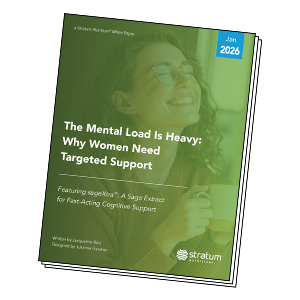
At Stratum Nutrition, a Missouri-based manufacturer, Jacqueline Rizo is public relations lead. Rizo stated that focusing on what’s working from the inside out is key in the women’s health market. “When we look at what is resonating most strongly in women’s health right now, it is clear that ingredients delivering visible, feelable benefits with strong scientific backing are leading the way,” said Rizo. “Collagen remains one of the most sought-after ingredient categories, particularly complexes that go beyond a single protein source and support skin elasticity, firmness, hydration, hair and nail strength, and overall connective tissue health,” she noted. “Women are becoming more interested in collagen solutions that work from the inside out and support both beauty and structural health as part of a long-term wellness strategy.”
Additionally, she noted, “Cognitive support ingredients are gaining significant traction as women look for solutions that help them stay sharp, focused, and mentally resilient through busy, demanding lives.”
Said Bailey, “A market report indicated that in 2025, the leading ingredient category for women’s health was vitamins and minerals stemming from health benefit categories such as bone health, prenatal health, and hormonal balance.7 That said, other ingredient types can also serve to support these categories, such as shatavari for hormonal balance,” Bailey noted. “In 2024, the global market size of shatavari was estimated to be $204.7 million, but by 2033, it could more than double, achieving a projected market size of $413.5 million,”8 said Bailey. “Vidya recently launched a combination of shatavari and ashoka extracts designed to support menopausal health known as ShataVida.”
Science and Ingredients in Women’s Health Products
Lannebere stated, “The bar is rising. Increasingly, brands and retailers want more than in-vitro data or traditional-use narratives,” she noted. “The strongest ingredient dossiers typically include: human clinical studies relevant to the target population—ideally including peri-/post-menopausal women when appropriate—with meaningful endpoints.” This could include validated questionnaires for mood/sleep, skin imaging for pigmentation, body composition markers or other tools, she explained. Mechanistic rationale—e.g., oxidative stress/inflammaging pathways, microbiome interactions or skin pigmentation pathways—are also important when looking at the science behind the ingredients today, as is quality and standardization. These, Lannebere stated, should include clear active markers, batch-to-batch consistency, and stability in finished forms. “In short: the science must be both clinically relevant and translatable into a consumer benefit without overstating claims,” she said.
McNamara noted that “The most trusted substantiation comes from well-designed human clinical trials, backed by mechanistic understanding and solid safety and tolerability data. In women’s health, the science is most valuable when it considers life stage, baseline status and outcomes that reflect real-world priorities, such as validated questionnaires, functional measures and relevant biomarkers when appropriate.”
Said Johnson, “Arjuna Natural is deepening its commitment to women’s health by conducting new clinical research on its Shoden ashwagandha extract. Previous studies have demonstrated its effectiveness for sleep and stress relief, but this latest research draws attention to its positive impact on brain fog and cognitive performance in women,” she stated. “Notably, the research found that a daily dose of just 60 mg led to a marked reduction in brain fog and improvements in cognitive function. The study is currently undergoing peer review, and more details will be available following publication.”
Mehta referred back to his earlier comments regarding an increasing number of aging women who experience dry eye symptoms. In general, he noted, that tear production decreases with age, and in women this is exacerbated due to hormonal changes. “Tears are made up of three layers,” he explained, “oil, water and mucus.” As hormones change, so too do the glands that produce the oil layer of the tear film in the eyes. This, he stated, often leads to lower quality tears, tear instability and rapid tear evaporation, all of which can contribute to eye dryness. This is where Unibar Corporation’s proprietary, patented, and branded formulation of capsanthin CapsiClear comes in. “A recent clinical study has shown that this specific branded capsanthin can increase tear volume and tear break-up time (TBUT) and decrease corneal inflammation,” he noted.9
At Vidya, Bailey stated, “The recently completed study utilized a double-blind, randomized, placebo-controlled design. The study found that just 100 milligrams per day of Shatavida helped to significantly reduce the severity of hot flashes and night sweats, while also helping to provide relief from fatigue and occasional bodily discomfort,” he said. The ingredient may help to support a restful sleep. “The positive changes observed in the study may in part be explained by the significant improvement in estradiol (E2). Low estrogen during menopause often manifests as hot flashes, flushes and night sweats,” he explained.
How Are Branded Product Manufacturers Using Key Ingredients in Women’s Health Products?
Rimel stated that GELITA’s bioactive collagen peptides are optimized for efficacy in diverse delivery formats. “From powders, to gummies, to beverages, to functional foods and more. These collagen peptides are also characterized by those aspects that make them an ideal choice for formulation,” she said, “Like being a source of conditionally essential amino acids, featuring high digestibility and bioavailability and presenting no adverse interactions.” Additionally, said Rimel, the bioactive collagen peptides offer an exceptional product profile, lending themselves to diversity and ease in formulation. Some of the perks include natural protein, a clean label, non-allergenic, excellent solubility, resistance to high pH and temperature, and a neutral odor and taste, among others.
At Kaneka Probiotics, Riera stated, “There are three key considerations. First, formulate for the life stage and indication. Women’s health needs differ significantly from menstruation and fertility through to menopause and healthy aging, so targeted solutions will resonate more than generic offerings,” he explained. “Second, choose efficient delivery formats; capsules remain popular for their ability to protect strains from stomach acid, but convenient formats like gummies are gaining traction,” he noted. “Third, prioritize clinically validated ingredients with proven mechanisms of action, which both consumers and retailers increasingly expect.”
At Unibar Corporation, Mehta noted that as the menopause market matures, the company anticipates a shift from one-size-fits-all products toward symptom-specific solutions. “Rather than generic menopause supplements, brands will develop comprehensive product lines addressing distinct symptoms,” he said. “This creates an ideal opportunity for ingredients like capsanthin and sea buckthorn oil, for example, in targeted dry-eye support supplements for menopausal women that combine capsanthin, sea buckthorn oil, and omega-3 fatty acids to address this specific, underserved need.”
The market for women’s health products is blossoming in new and unexpected ways. It’s encouraging to see that more time, energy and focus are being dedicated to women’s health and well-being. NIE
References:
1 Future Market Insights. (2025, July 1). “Women’s health supplement market size, trends & growth 2035.” www.futuremarketinsights.com/reports/womens-health-supplement-market.
2 Future Market Insights. (2025, May 3). “Women’s probiotic market size, growth, women’s wellness & demand.” www.futuremarketinsights.com/reports/women-probiotic-market.
3 The Menopause Society, (2025, October 15). “Risk of Dry Eye Disease Increases During Menopause Transition.” https://menopause.org/press-releases/risk-of-dry-eye-disease-increases-during-menopause-transition.
4 (n.d.). Organic Sea Buckthorn Pulp Oil. Unibar Corp. https://unibarcorp.com/products/sea-buckthorn-pulp-oil/.
5 Gabrielli, E et al. “Saccharomyces cerevisiae-based probiotic as novel anti-fungal and anti-inflammatory agent for therapy of vaginal candidiasis.” Beneficial Microbes vol. 9,2 (2018): 219-230. doi:10.3920/BM2017.0099.
6 Muniandy, et al. “Effects of Eurycoma longifolia Jack standardized water extract on well-being of peri-menopausal and post-menopausal women: protocol for a randomized, double-blinded, placebo-controlled, parallel group study” BMJ Open 2023 Nov 1;13(11):e073323.
7 Future Markets Insight, “Women’s Health Supplements Market Analysis – Size and Share Forecast Outlook 2025 to 2035.” www.futuremarketinsights.com/reports/womens-health-supplement-market.
8 Data Intello, “Shatavari Supplements Market Outlook” https://dataintelo.com/report/shatavari-supplements-market. 9 Shanmugham, V., & Subban, R. (2022). “Capsanthin from Capsicum annum fruits exerts anti-glaucoma, antioxidant, anti-inflammatory activity, and corneal pro-inflammatory cytokine gene expression in a benzalkonium chloride-induced rat dry eye model.” Journal of Food Biochemistry, 46(10), e14352. https://doi.org/10.1111/jfbc.14352.
* Side-bar start*
Ixoreal Biomed Launches SRI-81 Shatavari for Women’s Health
When natural products raw material supplier Ixoreal Biomed launched its flagship KSM-66 Ashwagandha ingredient (known as “King of Ayurvedic Herbs”), the company felt it natural that its second ingredient would be its counterpart shatavari (the “Queen of Herbs”) revered in ayurveda for women’s health. SRI-81 Shatavari was launched at SupplySide Global in October, 2025.
Shatavari has been linked for centuries with women’s health by supporting hormonal balance, reproductive health, lactation, menopause support and overall well-being.
“Yet, despite these quintessential benefits for women, shatavari has been largely overlooked in the global nutraceutical space. With SRI-81 Shatavari, we’re bringing the same scientific rigor, standardization, and credibility to Shatavari that we pioneered with KSM-66 Ashwagandha. For us, it is the right herb at the right moment: rooted in heritage, but with huge relevance for today’s consumers,” said an Ixoreal spokesperson.
According to the company, the U.S. market is one of the primary entry points given its scale, openness to innovation and readiness to embrace an ayurvedic ingredient that’s backed by science.
Long term, shatavari has the potential to play the same role in women’s health that ashwagandha now plays in stress and vitality, something that belongs in every household everywhere, the company stated.
*Side-bar end*
For More Information:
Arjuna Natural, www.arjunanatural.com
GELITA, www.gelita.com
Gnosis by Lesaffre, www.gnosisbylesaffre.com
HP Ingredients, www.hpingredients.com
Ixoreal, www.sri81.com
Kaneka Probiotics, https://kanekaprobiotics.com/
NEXIRA, www.nexira.com
Saanroo, www.saanroo.com
Stratum Nutrition, www.stratumnutrition.com
Unibar Corporation, www.unibarcorp.com
Vidya, www.vidyaherbs.com