There is a disturbing global paradox between the amount of food wasted and the hundreds of millions of people suffering from hunger and malnutrition. One-third of all food produced is wasted. This equates to a staggering $940 billion annually while 690 million people are malnourished and without access to the food they need for a healthy lifestyle.
Food waste is a multi-sectoral issue resulting in environmental, economic and ethical consequences. With the global population projected to reach 9.8 billion by 2050, over-exploitation of natural resources and increasing demand for food presents a major threat to environmental and societal welfare. Reduction of food waste is an undisputed requirement to supply the food needed to feed the exponentially growing global population. The food industry has a critical role in addressing this challenge. We need to continue to drive innovation forward, bringing more sustainable and nutritious food to market, in the right quantities that have been produced in the right way.
To do this, we need audacious innovation. When it comes to food waste, the ultimate goal is to realize a circular system keeping inputs and outputs within productive use, one that enables us as much as possible to reduce, reuse and recycle. Along with growing consumer demand for transparency, and focus on reducing food waste, advances in biotechnology, metabolomics, fermentation and artificial intelligence models are some examples of disruptive technologies that will enable the realization of circularity with respect to food production. Evolving regulations are also prompting the food industry into action, to rethink inefficient and wasteful linear models and to focus on reducing their overall carbon footprints.
There are advantages beyond the positive environmental and ethical impacts of reducing food waste. Research indicates that consumers will pay a premium for more sustainable products. Additionally, employees want to work for socially responsible companies that have a sustainability focus. Therefore, its desirable to be a leader and not a follower when it comes to evolving our food ingredients, processing and supply chain. There is tremendous value to be unlocked by partnering with suppliers that have sustainability at their core and can empower producers to reduce waste and improve their carbon footprint.
Where Is Food Wasted?
Food waste spans the entire supply chain from production and processing to retail and consumers. It can be categorized as:
1. Wasted resources: Use of material and energy that cannot be effectively regenerated over time, such as fossil energy and non-recyclable material.
• This can be improved through renewable energy and compositable, reusable or recyclable packaging.
2. Wasted capacity: Products that are not fully utilized across their shelf life.
• This can be improved through consumer education.
3. Wasted lifecycles: Products reaching end of life prematurely due to poor design.
• This can be improved at formulation.
4. Wasted embedded value: Components, material and energy not recovered from waste streams.
• This can be improved through upcycling.

Educating to Reduce Waste
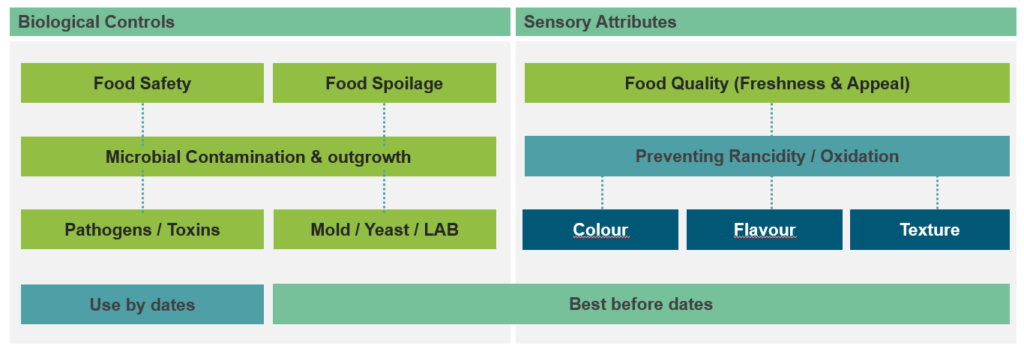
More consumer education is needed to address food waste and grow their understanding of its full impact. We’re starting to see brands talking more about their sustainability goals and how they are reducing waste which is a great step. Understanding the differences between best before and use by dates is a relatively simplistic but impactful step so food is not discarded prematurely. Many consumers do not understand the difference between a best before and use by date, yet the two have different definitions. Best before dates are about quality—they imply the end of optimal quality of the food. You can still eat food past this date, but it may not be at its best quality or have the same appeal. Use by dates are about safety, set using specific data from microbial challenge and spoilage studies. You have until the use by date to use or freeze the food before it may potentially become unsafe to eat. Education along with clear and consistent food labeling is key as we strive to ensure safe food is not discarded prematurely compounding our food waste challenges.
In addition to reducing waste, awareness of the carbon footprint of food can help consumers make sustainable purchase decisions, being mindful of production and waste impacts. For example, one pound of vegetable waste has a much different carbon footprint than a pound of red meat. Unprocessed vegetables and fruit tend to have a lower carbon footprint as compared to fresh meat, dairy and fish (as meat production naturally requires more energy and resources). This difference links to the sustainability halo around plant-based meat alternatives, though further processing must also be considered when calculating environmental impacts.
Formulating to Reduce Waste
From a food producer’s perspective, partnering with ingredient companies to extend the shelf life of products, while also meeting consumer demands for recognizable ingredients, is an important strategy in limiting food waste. A risk-based approach is followed to identify the optimal ingredient solution to apply. The relevant hazards, product characteristics, processing, storage and packaging conditions are considered. The combination of intrinsic, extrinsic and implicit variables impact which food poisoning or spoilage microorganisms are likely to grow. Kerry’s depth of expertise in food protection solutions and diverse tool kit encompassing vinegar, fermentation metabolites, cultures, flavor systems and plant extracts enables us to select the optimal solution for the application in addition to identifying synergies between ingredients to further enhance our differentiation.
Industry Examples
Let’s look at a few category examples where food producers have the opportunity to impact food waste.
Meat represents the category with the highest value of food waste. In addition to this substantial cost to consumers and the industry, meat is top of mind for food safety risk and prominent product recalls. Seventy percent of meat and poultry consumers want products with no artificial ingredients and three quarters of consumers indicate they are willing to pay more for a cleaner label.
Formulating meat products for food safety, and reduced waste without undesirable ingredients, is an ongoing challenge for the meat industry. We partner with customers to formulate for food safety in meat, elevating products’ shelf life and appeal with trusted, easy to use, consumer-friendly ingredients. Product success with “no artificial preservatives” claims is contingent on delivering shelf life days, without compromising on taste, nutrition and product appeal.
Bakery is the category that generates the highest volume of food waste. Natural positioning is an opportunity for producers to differentiate if they can do so while maintaining quality and without increasing waste in consumer homes or foodservice kitchens.
The bakery industry struggles with freshness and mold issues before food safety challenges like in meat. “No additives/preservatives” are popular claims with consumers and we work with customers who are reformulating in this space to overcome shelf life hurdles across multiple factors and leverage consumer-friendly ingredients to ensure their products are protected while maintaining great taste.
Meat alternatives have had widespread appeal propelled by sustainability and animal welfare concerns. We see this as a great impactful opportunity to partner with experts upfront, at formulation—preventing waste and avoiding recalls—as it is a category experiencing constant innovation while sharing similar food safety vulnerabilities to meat. Maximizing attainable shelf life by minimizing waste is imperative to enhance commercial success and speed to market.
There is added complexity in plant protein due to the wide variety of formulations and base proteins used which may have their own set of implicit and intrinsic factors influencing spoilage.
Additionally, many traditional preservatives contribute sodium to the final product. As the industry first had to conquer taste and appeal, many plant-based products are now working to reduce their sodium content to meet consumer needs for better health and nutrition. We are seeing a pull toward our food protection ingredients with low/no sodium contribution to the final product.
Many meat alternative products have stayed in the freezer case to avoid spoilage and quality risks over shelf life. The refrigerated plant-based category is growing at almost twice the pace of the frozen segment due to consumers perceiving refrigerated products as more premium, convenient and appealing. As a result, more industry players are looking to move to the refrigerator without compromising on quality or adding a long list of additives to their labels.
The Value of Partners with Sustainability at Their Core
Consumers want food that tastes great, is nutritious, affordable, convenient, labelled in a manner they understand and produced in a socially and environmentally responsible manner. Delivering this fast, in a sustainable, cost-effective way is key to having a competitive edge.
Kerry’s vision is to be our customers’ most valued partner, creating a world of sustainable nutrition and our business model supports this. Our sustainability strategy, Beyond the Horizon, supports our ambition to reach over two billion people with sustainable nutrition solutions by 2030. Through our innovation expertise, solutions portfolio and sustainability commitments, we will partner with customers to create products that are better for people, society and the planet.
We have a toolbox of solutions, experts as well as industry learnings and experience that empower our customers to innovate sustainably, helping them to reduce food waste and meet their own sustainability goals. NIE
Kerry’s food protection and preservation solutions:
• Maintain quality and freshness of foods and beverages over their shelf life
• Are built on a total concept approach to food safety
• Eliminate the need for post packaging processes and traditional preservatives
• Extend shelf life of natural products with an eye to reducing food waste
• Deliver cleaner labels that allow for positive claims by showcasing simple ingredient declarations
• Elevate taste and appeal
• Deliver consistent results in application
Vivien Sheehan, PhD, is global vice president of research, development & application within Kerry’s Applied Health and Nutrition division. She has made a distinguished contribution in the field of functional ingredients, supporting the introduction of new products to meet consumer demands for cleaner food and beverage labels. Her area of expertise is the development and optimization of fermentation-derived ingredients, in addition to developing innovative food safety solutions. Sheehan is a graduate of University of College Cork, Ireland with a Bachelor’s degree in food science and a subsequent PhD in microbiology.



![[Extra! Extra!] Talking Food-Bev Ingredients With Dr. Alvin Berger](https://niemagazine.com/wp-content/uploads/2024/05/Ingredients-for-food-and-drink-300x297-1716908098.jpg)